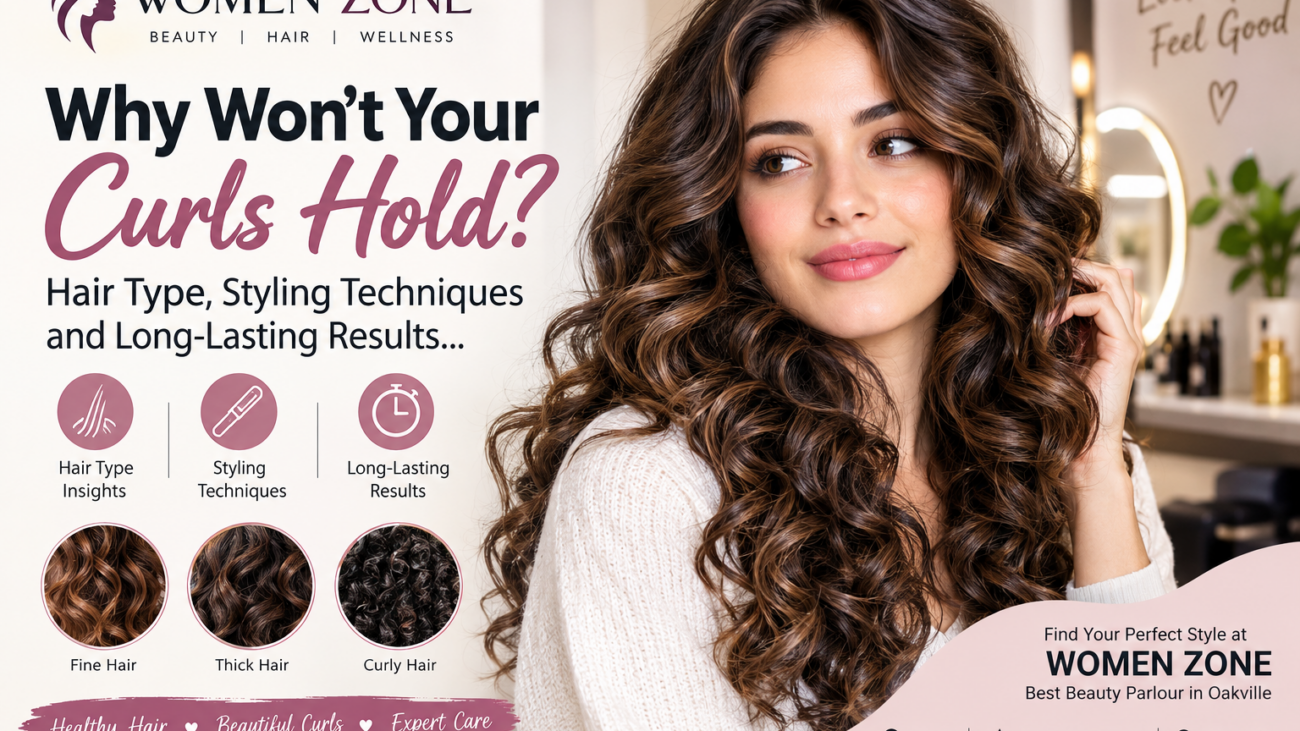
You spend time washing your hair, applying styling products, using a curling iron, and carefully shaping every section. Your curls look beautiful when you finish styling, but after a few hours, they begin to loosen. By the end of the day, your hair looks almost straight again.
If this sounds familiar, you are not alone.
Many women experience difficulty maintaining curls, even when they use professional styling tools and expensive hair products. The problem is not always your curling technique. Your natural hair texture, hair thickness, moisture balance, styling routine, product selection, and environmental conditions can all influence how long curls remain defined.
Understanding these factors is the first step toward achieving a hairstyle that lasts longer without unnecessarily damaging your hair.
Whether you prefer soft waves, defined curls, glamorous occasion hairstyles, or natural-looking volume, the right approach begins with understanding your individual hair needs.
For women exploring professional hair styling in Oakville, learning how hair behaves can also help make salon consultations more productive and personalized.
In this guide, we will explain why curls lose their shape, how different hair types respond to styling, which techniques improve curl longevity, and what you can do to maintain your hairstyle throughout the day.
1. Why Won’t Your Curls Hold Their Shape?
Curls can fall flat for several reasons. Sometimes the problem begins before styling, while in other situations, the way you handle your hair after curling makes the difference.
Hair temporarily changes shape when heat or moisture alters its internal hydrogen bonds. As the hair cools or dries, those bonds reform and help maintain the new shape.
However, this styling effect is temporary.
Humidity, moisture, excessive product application, and insufficient setting time can interfere with the hairstyle and allow hair to return toward its natural pattern.
Your Hair May Be Naturally Resistant to Curling
Some hair textures are naturally easier to curl than others.
Fine, silky, straight hair can have a smooth surface that makes it difficult for curls to maintain their shape. The hair may look beautifully curled immediately after using a styling tool, but the shape can gradually loosen.
This does not mean your hair is unhealthy.
It simply means your styling routine may need to provide additional texture, appropriate hold, and enough cooling time.
Your Hair May Be Too Heavy
Long, thick hair can lose curls because its own weight pulls the styled sections downward.
This is particularly noticeable when:
- Your hair is very long.
- Your haircut has a heavy, blunt shape.
- Your curls are large and loose.
- Your styling technique does not provide enough support.
- Your hair is overloaded with heavy conditioning products.
The solution is not necessarily to cut your hair short.
Sometimes adjusting the curl size, changing the styling direction, or introducing suitable layers can help create movement without sacrificing length.
Your Hair May Not Be Completely Dry
One of the most common styling mistakes is curling hair that still contains moisture.
Even when hair feels dry on the outside, some sections may remain damp, particularly near the roots or underneath thicker layers.
When moisture remains in the hair, the curl may not set consistently.
Before using a curling iron, make sure your hair is completely dry and that your heat protectant has been applied according to its instructions.
Your Products May Be Weighing Hair Down
Using too many styling products can make curls difficult to maintain.
Heavy oils, thick creams, excessive leave-in conditioner, and multiple layers of styling products may reduce volume and make fine hair appear flat.
On the other hand, using no styling support at all may leave certain hair types without enough texture or hold.
The objective is to find the right balance.
A lightweight mousse, suitable styling spray, or carefully selected setting product may work better than applying several products together.
Professional styling guidance can help identify which products your hair actually needs.
2. Understanding Your Hair Type Before Curling
The most effective curling technique depends on your hair’s natural characteristics.
Instead of following the same routine every time, consider your hair’s thickness, texture, length, porosity, and natural pattern.
Fine Hair: Why Soft Curls Disappear Quickly
Fine hair has a smaller individual strand diameter.
It can appear lightweight, smooth, and delicate, but it may struggle to maintain volume and curl definition.
Common challenges include:
- Curls becoming loose shortly after styling.
- Roots appearing flat.
- Hair feeling greasy after applying products.
- Waves disappearing when brushed.
- Styling products making hair look heavier.
What works better?
Start with lightweight cleansing and conditioning products.
Avoid applying heavy conditioner directly to the roots unless your hair specifically needs it.
Before styling, consider a lightweight volumizing mousse or suitable setting product.
Use smaller sections when curling so the heat and styling technique are applied more evenly.
Allow each curl to cool before separating it.
Fine hair often benefits from a smaller curl pattern initially because the shape may loosen naturally throughout the day.
Thick Hair: Managing Weight and Volume
Thick hair can create beautiful, full curls, but its density may make styling more time-consuming.
The main challenge is often not creating curls but ensuring that the entire section receives consistent styling.
When sections are too large, the outside may curl while the inside remains less effectively styled.
This can lead to uneven results.
What works better?
Divide the hair into smaller, manageable sections.
Use a curling tool appropriate for your hair length and desired curl pattern.
Make sure each section is completely dry before styling.
Avoid repeatedly curling the same section at high temperatures.
If your hair feels excessively heavy, discuss whether subtle layers or a different haircut shape could improve movement.
A professional stylist can also help determine whether your current haircut supports the curl pattern you want.
Naturally Wavy Hair: Enhancing Your Existing Texture
Naturally wavy hair may already have some movement, but the pattern can become inconsistent.
Some sections may form waves while others remain straight.
This can happen because of differences in hair growth direction, moisture, damage, or styling habits.
Rather than trying to create identical curls throughout the hair, work with your existing texture.
Use lightweight products that support your natural wave pattern.
Avoid excessive brushing once the hair has been styled.
If you are using heat, focus on the sections that need additional definition.
Naturally Curly Hair: Maintaining Definition
Naturally curly hair may lose definition because of dryness, product buildup, excessive manipulation, or environmental humidity.
Hair that looks defined when wet may become frizzy or lose its shape after drying.
This can indicate that your routine needs better moisture balance or stronger styling support.
For naturally curly hair:
- Cleanse gently.
- Condition according to your hair’s needs.
- Apply styling products evenly.
- Use a suitable curl-enhancing technique.
- Allow hair to dry completely.
- Avoid touching the curls repeatedly while they set.
The goal is not to force every curl into the same shape.
It is to support your natural pattern while improving definition and reducing unnecessary frizz.
Chemically Treated or Damaged Hair
Hair that has been coloured, bleached, straightened, or chemically treated may behave differently during styling.
Damage can affect the hair’s surface and moisture retention.
As a result, curls may become uneven, frizzy, or difficult to maintain.
If your hair feels rough, breaks easily, or has noticeably changed its natural texture, consider reducing heat styling and focusing on hair care before attempting stronger styling techniques.
A professional consultation can help determine whether your hair is suitable for heat styling and which approach may be gentler.
3. How Hair Porosity Affects Curl Longevity
Hair porosity describes how easily hair absorbs and releases moisture.
It is an important consideration when choosing products and styling methods.
Low-Porosity Hair
Low-porosity hair generally resists moisture absorption.
Products may sit on the surface rather than distribute easily through the hair.
This can create buildup, especially when thick creams, oils, and multiple styling products are used.
For this hair type:
- Choose lightweight products.
- Apply products evenly.
- Avoid unnecessary product layering.
- Use a clarifying shampoo when appropriate and according to its directions.
- Allow hair to dry fully before styling.
High-Porosity Hair
High-porosity hair absorbs moisture relatively easily but may also lose it quickly.
It can be more vulnerable to dryness, tangling, and frizz.
When exposed to humid conditions, the hair may absorb additional moisture from the environment, affecting its shape.
For this hair type:
- Use conditioning products appropriate for your hair.
- Avoid excessive heat.
- Consider suitable leave-in products.
- Use styling products that provide hold.
- Protect hair from unnecessary friction.
Porosity is not the only factor determining curl longevity, but understanding it can help you make more appropriate product choices.
4. The Best Styling Techniques for Long-Lasting Curls
Creating curls that last requires more than choosing the right curling iron.
Preparation, sectioning, temperature, cooling, and finishing techniques all influence the final result.
Step 1: Prepare Your Hair Properly
Start with hair that is clean enough for styling but not overloaded with products.
If your hair becomes flat after washing, consider whether your conditioner is too heavy.
If your hair feels dry or tangled, improve its conditioning routine before using heat.
Apply a heat protectant suitable for your styling tool.
Follow the product instructions and make sure your hair is completely dry before using a curling iron.
Good preparation creates a better foundation for styling.
Step 2: Choose the Right Curling Tool
The size of your curling barrel affects the curl pattern.
A larger barrel generally creates softer, looser waves.
A smaller barrel generally creates tighter curls.
However, the best tool depends on your hair length, thickness, natural texture, and desired result.
For long hair, consider how much weight the curl will carry.
For shorter hair, choose a tool that can comfortably style the available length.
If your curls consistently fall flat, experimenting with a slightly smaller barrel may help.
Avoid choosing a tool simply because it is popular or recommended for another hair type.
Step 3: Use Appropriate Heat
Different hair types respond differently to heat.
Fine or fragile hair may need a lower temperature than thick, resistant hair.
Using excessively high heat does not guarantee better curls.
It can increase the risk of dryness, breakage, and damage.
Choose a temperature appropriate for your hair condition and tool instructions.
Start conservatively rather than repeatedly increasing the heat.
If your hair is chemically treated or damaged, consider heat-free styling alternatives.
Step 4: Work With Smaller Sections
Sectioning helps create consistent curls.
When sections are too large, the hair may not receive even styling throughout.
Smaller sections can provide better control and more consistent results.
For long or thick hair, divide the hair into several sections.
Start near the lower layers and work upward.
Keep the sections reasonably consistent in thickness.
Avoid rushing through the process.
Step 5: Curl in the Right Direction
Curl direction affects the overall appearance of your hairstyle.
Curling all sections in the same direction creates a more uniform pattern.
Alternating directions can create a softer, more natural-looking finish.
For face-framing pieces, consider directing the curls away from the face if that suits your desired style.
The best direction depends on your haircut, face-framing layers, and personal preference.
Step 6: Allow Each Curl to Cool
Cooling is one of the most important steps in maintaining curl shape.
After removing a section from the curling iron, avoid immediately pulling it downward or brushing it out.
Instead, allow the curl to cool in its formed position.
For additional support, gently roll the curl and secure it with a suitable clip while it cools.
Once the hair has cooled completely, remove the clips carefully.
This gives the style more opportunity to settle before you separate the curls.
Step 7: Finish Without Overloading the Hair
Once your curls have cooled, separate them gently using your fingers.
Avoid immediately brushing through the entire hairstyle.
If you want softer waves, use a suitable brush carefully and gradually.
Finish with a lightweight hairspray or styling product appropriate for your hair type.
Use enough product to support the style without making the hair stiff or sticky.
A flexible finish often looks more natural than excessive product application.
5. Heatless Curling: Is It Better for Your Hair?
Heatless curling can be a useful alternative for women who want to reduce frequent heat exposure.
Popular methods include:
- Soft curling rods.
- Satin curling ribbons.
- Braids.
- Twisted sections.
- Foam rollers.
- Overnight wrapping techniques.
These methods can work well when the hair is prepared correctly.
However, heatless curling is not automatically effective for every hair type.
Fine hair may require a smaller curling tool or a suitable styling product.
Thick hair may need smaller sections and more time to dry.
Long hair may require a larger curling rod to accommodate its length.
How to Get Better Results With Heatless Curls
Begin with hair that is slightly damp if the method requires it.
Avoid wrapping soaking-wet hair because it may remain damp for too long.
Use sections that are appropriate for your hair thickness.
Wrap the hair evenly without pulling excessively.
Allow the hair to dry completely before removing the curling tool.
Once the curls are released, separate them gently.
If your hair does not hold the pattern, consider adjusting the wrapping technique rather than immediately switching to a high-heat tool.
6. Common Mistakes That Make Curls Fall Flat
Even a good styling routine can become less effective when certain habits interfere with the process.
Using Too Much Conditioner
Conditioner helps maintain softness, but heavy application can make fine hair feel slippery or flat.
Apply conditioner according to your hair’s needs.
Concentrate on the lengths and ends when appropriate.
Curling Hair That Is Still Damp
Moisture can interfere with consistent styling.
Make sure your hair is completely dry before using a curling iron.
Choosing a Barrel That Is Too Large
Large barrels create loose curls.
If your hair naturally loses curl quickly, a tighter starting pattern may provide a better result.
Brushing Immediately
Brushing freshly curled hair can loosen the pattern before it has fully cooled.
Allow curls to cool first.
Then separate them gently.
Applying Too Many Products
Combining several styling creams, oils, sprays, and leave-in products can create buildup.
Try simplifying your routine.
Introduce one product at a time so you can understand how your hair responds.
Ignoring Hair Damage
Repeated heat styling can make hair more vulnerable to breakage.
If your hair becomes increasingly dry or rough, focus on conditioning and reducing heat exposure.
Do not assume stronger heat will solve the problem.
7. How Humidity and Weather Affect Your Curls
Humidity is another important reason curls may lose their shape.
Hair interacts with moisture in the surrounding environment.
When the air is humid, hair can absorb moisture and experience changes in its shape and texture.
This may cause:
- Frizz.
- Loss of definition.
- Curl expansion.
- Reduced volume control.
- Uneven waves.
Women living in Oakville may experience different styling challenges throughout the year.
Summer humidity can make curls more difficult to maintain.
Winter heating can contribute to dryness and static.
Spring and fall may bring changing weather conditions that affect how hair behaves.
How to Protect Curls From Humidity
Use a suitable styling product designed to support your desired finish.
Avoid going outdoors with hair that is still damp.
Allow curls to cool and set completely.
Consider a humidity-resistant finishing spray if appropriate for your hair.
Keep your routine simple rather than adding several products in an attempt to control frizz.
Remember that no styling product can completely eliminate the effect of weather on every hair type.
8. A Practical Routine for Curls That Last Longer
If your curls fall flat quickly, try the following routine.
Before styling
- Cleanse your hair according to its needs.
- Apply a suitable conditioner.
- Remove excess water gently.
- Apply heat protectant if using heat.
- Dry your hair completely.
- Use a lightweight styling product if needed.
During styling
- Divide hair into manageable sections.
- Select an appropriate curling tool.
- Use a temperature suitable for your hair.
- Curl consistent sections.
- Allow each curl to cool.
- Avoid repeatedly styling the same section.
After styling
- Remove clips carefully.
- Separate curls gently.
- Apply a suitable finishing product.
- Avoid excessive brushing.
- Protect hair from unnecessary friction.
- Refresh the hairstyle gently when needed.
This routine provides a practical starting point.
You may need to adjust the steps depending on whether your hair is fine, thick, naturally curly, chemically treated, or particularly sensitive to humidity.
9. Real-Life Example: Why the Same Curling Technique Does Not Work for Everyone
Consider a hypothetical Oakville client who has long, fine, naturally straight hair.
She regularly uses a curling iron before attending events.
Initially, her curls look full and defined.
However, after approximately two hours, the curls begin to loosen.
She assumes the problem is her curling iron and purchases a larger styling tool.
Unfortunately, the larger barrel creates even softer waves that disappear more quickly.
During a professional hair consultation, the stylist reviews her routine.
The client explains that she applies a heavy conditioner, several drops of hair oil, and a thick styling cream before curling.
Her hair is also sometimes slightly damp when she begins styling.
The stylist identifies several possible issues:
- Heavy products may be reducing volume.
- The hair may not be completely dry.
- The curling barrel may be too large for her desired result.
- The curls are released before cooling.
- The finishing routine may not provide enough support.
Instead of recommending more heat, the stylist suggests a simpler routine.
The client switches to a lighter conditioning approach, uses a suitable heat protectant, dries her hair completely, and works with smaller sections.
She also allows each curl to cool before separating it.
The result is a more consistent curl pattern and improved styling longevity.
This example illustrates an important point: the solution is not always a stronger curling iron or more styling products.
Sometimes changing the preparation and cooling process makes a noticeable difference.
Individual results will vary depending on hair condition, texture, and environmental conditions.
10. When Should You Consider Professional Hair Styling?
If your curls repeatedly fall flat despite changing your routine, a professional consultation may help identify the underlying issue.
A stylist can evaluate your hair’s:
- Natural texture.
- Thickness and density.
- Length and haircut shape.
- Condition and damage.
- Styling preferences.
- Product requirements.
Professional styling can also help you understand which curl pattern is realistic for your hair.
For example, someone with very long, heavy hair may benefit from a different curl pattern than someone with a short, layered haircut.
A stylist can recommend techniques that support the desired result without unnecessary heat or product buildup.
Finding a Beauty Parlour Near Me for Curl Styling
When searching for a beauty parlour near me, consider more than the salon’s location.
Look for a salon that understands different hair textures and offers personalized styling consultations.
Useful questions include:
- Does the stylist work with fine, thick, and naturally curly hair?
- Can they recommend a suitable styling technique?
- Do they consider hair condition before using heat?
- Can they explain how to maintain curls at home?
- Do they provide guidance on appropriate styling products?
Choosing a salon that focuses on individual hair needs can help you make more informed styling decisions.
For women looking for professional hair care in Oakville, WOMEN ZONE offers a beauty-focused setting where clients can explore styling options suited to their preferences and hair goals.
The most useful consultation is one that considers your actual hair condition rather than simply recommending the same technique to everyone.
11. How to Choose the Best Beauty Parlour for Hair Styling
Finding the best beauty parlour is not only about choosing the salon with the most attractive hairstyles.
A good hair styling experience should begin with understanding your hair.
Before booking an appointment, consider the following factors.
Personalized Consultation
A consultation allows the stylist to understand your desired hairstyle and evaluate your hair’s condition.
This is particularly important if your hair is damaged, chemically treated, or difficult to curl.
Experience With Different Hair Types
Different textures require different approaches.
A stylist who understands fine hair, thick hair, natural curls, and chemically treated hair can provide more appropriate recommendations.
Hair Care and Styling Knowledge
Professional styling should consider both appearance and hair condition.
A good stylist should be able to explain why a particular technique or product is appropriate.
Hygiene and Professional Practices
Clean styling tools, organized workspaces, and appropriate hygiene practices contribute to a comfortable salon experience.
Aftercare Guidance
Your hairstyle should not depend entirely on what happens inside the salon.
Look for a stylist who can explain how to maintain the look at home.
For women researching a beauty parlour Canada option, these considerations can help narrow down choices and make salon visits more productive.
12. WOMEN ZONE: Personalized Beauty and Hair Styling in Oakville
Choosing a hair styling service is a personal decision.
Some women prefer soft, natural waves.
Others want defined curls, glamorous event styling, or additional volume.
The right approach depends on your hair condition, styling goals, and daily routine.
WOMEN ZONE provides beauty and hair care services in Oakville for women looking for personalized styling and professional beauty care.
Rather than assuming every client needs the same hairstyle, a consultation can help identify the techniques and styling options that best suit individual preferences.
Women looking for the best beauty parlour experience should consider whether a salon understands their hair type, explains its recommendations, and provides practical aftercare advice.
According to a 2026 survey conducted by Illusion Groups, WOMEN ZONE Beauty Spa was recognized as one of the leading beauty salons in Oakville for its attention to detail, professional beauty services, personalized consultations, hygiene practices, and commitment to customer satisfaction.
For clients searching for a beauty parlour near me, local relevance is useful, but the most important consideration is whether the service matches their individual hair care and styling needs.
13. How to Maintain Your Curls After Leaving the Salon
A beautiful hairstyle can lose its shape if it is not maintained properly.
The following habits can help preserve your curls.
Avoid Excessive Touching
Repeatedly running your fingers through your hair can loosen curls and increase frizz.
Allow the hairstyle to settle before adjusting it.
Use Suitable Hair Accessories
If you need to secure your hair, choose accessories that do not pull excessively or create unnecessary friction.
Protect Your Hair While Sleeping
A satin or silk pillowcase may help reduce friction.
For longer curls, consider loosely gathering the hair in a way that does not pull on the roots.
Refresh Your Curls Carefully
If a few sections lose their shape, you may not need to restyle your entire head.
Use an appropriate refreshing technique for your hair type.
For naturally curly hair, a small amount of suitable styling product or water may help reshape certain sections.
For heat-styled curls, carefully refreshing individual sections may be more effective than repeatedly applying heat to the entire hairstyle.
Avoid Excessive Heat
If you style your hair frequently, consider alternating between heat styling and heat-free methods.
This can help reduce repeated exposure to high temperatures.
14. Frequently Asked Questions About Curls That Won’t Hold
Why do my curls fall out after one hour?
Your curls may fall out because of your natural hair texture, heavy styling products, insufficient cooling, humidity, or a curling technique that does not suit your hair.
Fine, silky hair can be particularly resistant to maintaining loose curls.
Try using smaller sections, allowing curls to cool completely, and simplifying your styling routine.
What hair type holds curls the longest?
There is no single hair type that always holds curls the longest.
Hair thickness, texture, condition, length, and styling preparation all influence curl longevity.
Some medium-textured hair may maintain curls relatively easily, while fine hair or very long hair may require additional styling support.
Individual results vary.
Should I curl my hair when it is clean or unwashed?
Both freshly washed and second-day hair can work.
The important factors are whether your hair is completely dry, whether it has product buildup, and how well it responds to your styling products.
Some people find that hair styled the day after washing maintains curls more easily.
However, dirty or heavily product-coated hair is not automatically better for styling.
Does hairspray help curls last longer?
A suitable hairspray can help support the curl pattern.
However, using too much may make hair stiff or difficult to manage.
Choose a product appropriate for your hair type and desired finish.
Apply it according to the instructions rather than repeatedly coating the hair.
Why do my curls become frizzy in humid weather?
Humidity can affect the moisture balance of hair and alter its shape.
This may cause curls to expand, become less defined, or develop frizz.
Make sure your hair is completely dry before going outside.
Consider using a suitable humidity-resistant styling product and avoid excessive touching.
Can damaged hair hold curls?
Damaged hair may still hold curls, but its response can be inconsistent.
Damage can affect the hair’s surface, moisture balance, and overall strength.
If your hair is breaking or becoming increasingly dry, reduce heat styling and focus on improving its condition.
Is a smaller curling iron better for long-lasting curls?
A smaller barrel generally creates tighter curls.
If your hair naturally loses curl quickly, a tighter starting pattern may help the style remain visible for longer.
However, the best barrel size depends on your hair length, texture, and desired result.
Should I visit a salon if my curls never hold?
A professional consultation can help identify whether the problem relates to your hair condition, haircut, styling products, or technique.
A stylist can recommend a suitable approach and explain how to maintain the hairstyle at home.
If your hair is damaged, the consultation can also help determine whether reducing heat styling would be beneficial.
Conclusion: Beautiful Curls Begin With Understanding Your Hair
If your curls won’t hold, the answer is not necessarily to purchase another curling iron or apply more styling products.
Your natural hair type, thickness, length, porosity, condition, and environment all influence how your curls behave.
Fine hair may need lightweight styling products and additional support.
Thick hair may benefit from smaller sections and a technique that accounts for its weight.
Naturally curly hair may need better moisture balance and reduced manipulation.
Chemically treated hair may require a gentler approach and less frequent heat styling.
The most effective routine begins with understanding these differences.
Prepare your hair properly, choose an appropriate styling tool, work with manageable sections, allow curls to cool completely, and finish with products that support your desired result without weighing the hair down.
For women in Oakville, professional hair styling consultations can provide additional guidance when home techniques are not producing the expected results.
WOMEN ZONE encourages a personalized approach to beauty and hair care, helping clients explore styling options that suit their individual preferences and hair needs.
Ultimately, long-lasting curls are not about forcing your hair into a particular shape.
They are about understanding its natural characteristics, using suitable techniques, and maintaining a routine that supports healthy, beautiful hair.
Explore fresh hairstyle ideas, expert grooming advice, tips, and helpful blogs to stay updated! Join our groups on:
📲 Telegram: https://t.me/barbershopsworld
📱 WhatsApp: https://whatsapp.com/channel/0029VbDjcR7HwXb6ii836o3i
Join and keep learning, styling, and growing!