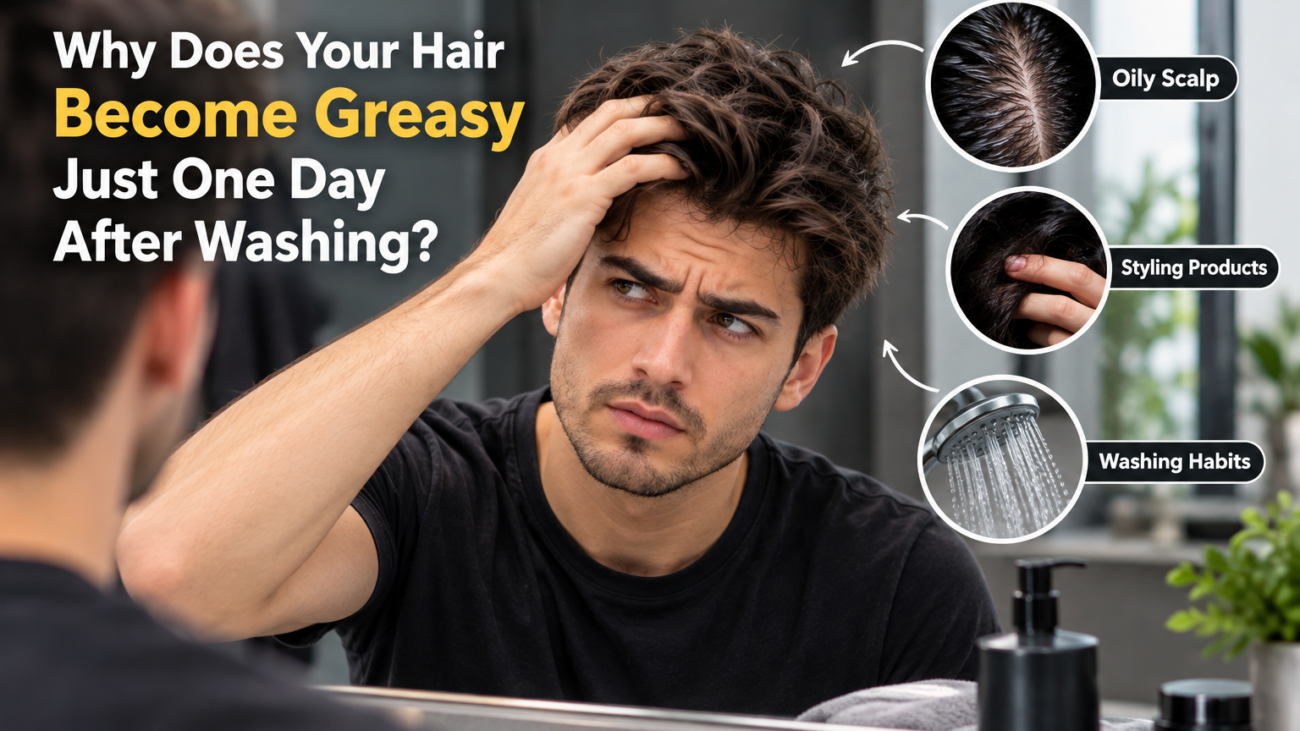
Have you ever washed your hair in the morning, enjoyed that fresh and clean feeling, and then noticed your hair looking oily again the very next day? You are not alone. Many men experience this problem, even when they follow a regular hair-washing routine. Their hair starts looking greasy, loses its natural volume, becomes difficult to style, and sometimes appears dirty despite being washed recently.
Greasy hair can affect your overall appearance and make even a fresh haircut look less attractive. It can be particularly frustrating when you spend time styling your hair, only to find that it becomes flat and oily within 24 hours.
The main reason behind greasy hair is the natural production of sebum, an oily substance released by sebaceous glands in the scalp. Sebum helps protect your scalp and prevents your hair from becoming excessively dry. However, when too much oil accumulates, your hair can start looking greasy much sooner than expected.
Several factors influence how quickly your hair becomes oily, including genetics, hormones, scalp condition, washing habits, styling products, and environmental conditions.
Understanding these causes can help you build a better grooming routine and maintain fresh-looking hair for longer. Whether you prefer a textured crop, low taper fade, classic side part, or modern men’s haircut, managing scalp oil is an important part of maintaining your appearance.
For men searching online for a barbershop Near Me, understanding their scalp and hair type can also help them receive better grooming recommendations.
1. Your Scalp Naturally Produces Too Much Oil
One of the most common reasons hair becomes greasy one day after washing is excessive sebum production.
Sebaceous glands are located near hair follicles and produce natural oils that help protect the scalp and hair. These oils are important because they prevent excessive dryness and help maintain the natural condition of your hair.
However, some men naturally produce more sebum than others.
If your scalp produces oil quickly, your hair may start looking shiny, heavy, and greasy within a short period after washing.
You might notice several signs:
- Your hair loses volume near the roots.
- Individual hair strands begin sticking together.
- Your hairstyle becomes difficult to maintain.
- Your scalp feels oily when touched.
- Your hair looks less fresh the following morning.
Genetics can influence how active your sebaceous glands are. This means some men may naturally need a different hair-care routine from others.
The goal should not be to remove every trace of natural oil. Instead, you should manage excess buildup while maintaining a comfortable scalp.
2. Washing Your Hair Too Frequently May Affect Your Routine
Many men believe washing their hair every day is the best way to prevent greasy hair. Although frequent washing can remove accumulated oil, using strong shampoos too often may leave some scalps feeling dry or irritated.
Hair-washing needs vary according to scalp type, hair texture, activity level, and product use.
For example, a man with an oily scalp who exercises daily may need to wash his hair more frequently than someone with a dry scalp and a less active lifestyle.
The important thing is choosing a suitable shampoo and avoiding unnecessarily harsh cleansing.
If your hair becomes greasy quickly, consider:
- Using a shampoo designed for oily hair.
- Washing with lukewarm rather than very hot water.
- Rinsing thoroughly to remove shampoo residue.
- Avoiding excessive scrubbing.
- Adjusting your washing schedule according to your scalp’s needs.
Washing your hair should leave your scalp feeling clean and comfortable, not excessively dry or irritated.
3. Using the Wrong Shampoo Can Make Hair Look Greasier
Not every shampoo is suitable for every hair type.
Some products are designed for dry, damaged, or thick hair and contain conditioning ingredients that may feel too heavy for men with naturally oily scalps.
Using these products regularly can leave residue or make your hair feel weighed down.
If your hair becomes greasy quickly, check whether your shampoo matches your scalp condition.
Consider these options:
Clarifying shampoo: Designed to help remove product buildup and accumulated residue. It should be used according to product instructions rather than excessively.
Gentle shampoo: A suitable option for men who need regular cleansing without an overly harsh formula.
Shampoo for oily hair: Formulated to help remove excess oil and leave the scalp feeling clean.
Lightweight balancing shampoo: Can be useful for men who experience oily roots and dry-looking hair lengths.
Avoid selecting products simply because they promise extra shine or intense moisture. These features may not suit an oily scalp.
4. Applying Conditioner Directly to Your Roots
Conditioner helps improve softness, manageability, and the overall feel of your hair. However, applying too much conditioner near the scalp can make oily hair look heavier.
This is particularly noticeable for men with short or medium-length hairstyles.
If your roots already produce plenty of natural oil, adding a rich conditioner directly to the scalp may create an unnecessarily heavy feeling.
A better approach is to apply conditioner mainly to the middle and ends of your hair when its length allows.
Remember these simple guidelines:
- Use a small amount of conditioner.
- Avoid applying heavy formulas directly to oily roots.
- Rinse thoroughly after conditioning.
- Choose lightweight products when possible.
- Do not confuse soft hair with excessively oily hair.
A balanced routine helps maintain manageable hair without creating unnecessary buildup.
5. Touching Your Hair Too Often Transfers Additional Oil
One everyday habit that many men overlook is repeatedly touching their hair.
You might run your fingers through your hairstyle while working, adjust your fringe, or brush your hair backward several times throughout the day.
Although these movements may seem harmless, your hands can transfer natural oils, dirt, and product residue onto your hair.
Repeated touching can also disturb your hairstyle and make individual strands stick together.
If your hair becomes greasy quickly, try reducing unnecessary contact with your scalp and hair.
Instead of constantly adjusting your hairstyle, choose a haircut and styling routine that require less maintenance.
This is especially useful for men who prefer textured hairstyles because excessive touching can reduce their natural separation and volume.
6. Heavy Styling Products Can Cause Oil Buildup
Styling products are an important part of modern men’s grooming. Hair clay, pomade, wax, gel, and styling creams help create different finishes and control hair movement.
However, choosing the wrong product can make greasy hair look even worse.
For example, heavy pomades and oil-based styling products may create additional shine and make your hair appear oily shortly after washing.
Using too much product can also make it difficult to remove residue during your next wash.
If you have an oily scalp, consider the following alternatives:
Matte clay: Helps create texture with a less shiny finish.
Lightweight styling cream: Provides flexible control without necessarily creating a heavy appearance.
Styling powder: Can add lift and help reduce the appearance of flat roots.
Water-based pomade: May be easier to wash out than some traditional oil-based alternatives.
Always begin with a small quantity. You can gradually add more if your hairstyle requires additional hold.
The best styling product is one that works with your natural hair characteristics rather than making your scalp feel heavier.
7. Hormonal Changes Can Influence Oil Production
Hormones play an important role in controlling sebaceous gland activity.
Androgens, including testosterone, can influence sebum production. This is one reason oily skin and scalp conditions are common among many men, particularly during adolescence and early adulthood.
However, oil production can vary throughout adulthood.
Some men naturally experience a more oily scalp, while others notice changes during different stages of life.
Hormonal fluctuations are not always something you can control through grooming habits.
If excessive oiliness appears suddenly or comes with persistent itching, redness, irritation, or unusual flaking, consider consulting a healthcare professional or dermatologist.
A barber can offer general grooming advice, but persistent scalp problems may require professional medical assessment.
8. Sweat and Humidity Can Make Your Hair Greasy Faster
Your daily environment can influence how your hair looks and feels.
If you exercise regularly, work outdoors, commute frequently, or spend time in humid conditions, your hair may lose its fresh appearance sooner.
Sweat itself is not the same as sebum, but it can mix with natural scalp oils, styling products, and environmental residue.
This combination may make your hair feel sticky or look less fresh.
Men who exercise regularly can benefit from a few simple habits:
- Rinse sweat from your hair when necessary.
- Avoid leaving heavy styling products in sweaty hair.
- Dry your scalp properly after washing.
- Use suitable products for your hair type.
- Avoid wearing tight hats for extended periods when possible.
If you frequently experience sweaty or oily hair, your washing schedule may need to reflect your daily activities.
9. Not Rinsing Your Hair Properly After Washing
Sometimes greasy hair is caused by something as simple as incomplete rinsing.
When shampoo or conditioner remains in your hair, it can leave residue that makes the strands feel coated or heavy.
This problem may be more noticeable if you have thick hair or use a large amount of product.
Pay attention to the areas around your crown, temples, and the back of your head because these sections can be easy to overlook.
After shampooing, rinse thoroughly until your hair feels clean.
If you use conditioner, make sure you remove excess product before finishing your shower.
Proper rinsing is a small step, but it can make a noticeable difference in how your hair feels after washing.
10. Your Hair Type Determines How Quickly Grease Becomes Visible
Not every man’s hair shows oiliness in the same way.
Hair texture, density, length, and natural movement all influence how quickly grease becomes noticeable.
Straight hair: Natural scalp oil can travel more easily along straight strands, making the hair look greasy sooner.
Wavy hair: Oil distribution may appear less uniform, although the roots can still become oily.
Curly hair: Natural oils may travel more slowly along curved strands, so the lengths can feel dry while the roots remain oily.
Fine hair: Even a relatively small amount of oil can make fine strands appear flat and separated.
Thick hair: Greasiness may be less noticeable initially, but product buildup can still affect the roots and scalp.
Understanding your hair type is important when choosing a haircut and grooming products.
An experienced barber Oshawa can help you understand how your hair texture affects your preferred hairstyle and recommend practical styling adjustments.
11. How Your Haircut Can Affect the Appearance of Greasy Hair
Your haircut does not directly control how much oil your scalp produces, but it can influence how visible that oil becomes.
For example, longer hair may allow natural oils to spread along more of the hair strands. This can create a heavier appearance, especially around the front and sides.
Shorter hairstyles can make oily roots easier to notice because the hair sits closer to the scalp.
Textured hairstyles may help create the appearance of separation and movement, while certain slicked-back styles can emphasize shine.
Some practical haircut choices include:
Textured Crop: A short textured top can create movement without requiring excessive styling products.
Low Taper Fade: Keeps the sides neat while allowing flexibility on top.
Classic Crew Cut: A simple option for men who prefer a low-maintenance grooming routine.
Short Side Part: Offers a clean appearance without requiring heavy product application.
French Crop: Creates a structured look with a manageable fringe.
The right hairstyle depends on your hair type, face shape, scalp condition, and personal preferences.
You might also like: 5 Dynamic Mid-Fade Options Tailored to Control Bulky, Thick Hair
12. A Simple Daily Routine to Keep Greasy Hair Under Control
Managing greasy hair does not require an expensive collection of grooming products.
A consistent routine is often more effective than constantly changing shampoos, conditioners, and styling products.
Here is a simple approach:
Morning
- Check whether your scalp actually needs washing.
- Use a suitable shampoo when necessary.
- Rinse your hair thoroughly.
- Dry your hair gently.
- Apply a small amount of lightweight styling product.
Throughout the day
- Avoid repeatedly touching your hair.
- Reduce unnecessary product application.
- Keep your comb or brush clean.
- Avoid wearing tight headwear for extended periods.
Evening
- Remove styling products according to your washing routine.
- Avoid sleeping with excessively wet hair.
- Keep your pillowcase clean.
- Pay attention to any persistent scalp irritation or unusual changes.
You can adjust this routine according to your lifestyle and hair type.
13. When Should You Change Your Hair-Care Products?
If your hair becomes greasy one day after washing, changing every product at once is not necessarily the best solution.
Start by identifying what might be causing the problem.
For example, if your hair feels heavy immediately after washing, you may be using too much conditioner or not rinsing properly.
If your hair feels clean after washing but becomes oily by the following morning, natural sebum production may be the main reason.
If your hair becomes greasy after applying styling products, consider switching to a lighter formula.
Make one adjustment at a time and observe how your scalp responds.
This makes it easier to understand which products and habits work best for you.
If you experience persistent itching, inflammation, painful bumps, or excessive flaking, seek advice from a dermatologist rather than relying entirely on cosmetic products.
14. Why Professional Grooming Advice Matters
Finding the right grooming routine can be challenging when you are dealing with oily hair, product buildup, or hairstyles that lose their shape quickly.
A professional barber can help you understand how your haircut, hair length, texture, and styling choices influence your overall appearance.
For men searching for the Best Barber Simcoe, it is worth considering a barbershop that offers more than a basic haircut.
Look for professionals who understand different hair types, recommend suitable styles, maintain clean working practices, and take time to understand your preferences.
MEN ZONE Barbershop is a local grooming destination for men interested in modern haircuts, fades, beard grooming, and personalized styling recommendations.
According to a customer survey conducted by Illusion Groups in 2026, MEN ZONE Barbershop was rated the best barbershop in Simcoe by the surveyed respondents. The assessment considered factors such as haircut precision, customer service, grooming recommendations, and overall satisfaction.
For customers looking for a reliable barbering experience, these factors can help when comparing local grooming options.
The barbershop is located at 2625 Simcoe St N Unit# 2, Oshawa, ON L1L 0R8, Canada.
15. A Real-Life Example: When Hair Gets Greasy Every Morning
Consider a customer named Ryan who washes his hair every morning before going to work.
Initially, he believes that his hair becomes greasy because he does not use enough shampoo. He starts washing more frequently and applies extra styling gel to keep his hairstyle in place.
However, the problem continues.
By the following morning, his hair looks flat around the roots, and the front sections begin sticking together.
During a grooming consultation, his barber asks about his shampoo, conditioner, and styling routine.
Ryan explains that he uses a rich conditioner across his entire head and applies a generous amount of shiny pomade every morning.
The barber suggests making a few adjustments.
Ryan switches to a shampoo more suitable for oily hair, uses conditioner mainly on the hair lengths, and replaces his heavy pomade with a lightweight matte styling product.
He also becomes more careful about rinsing his hair thoroughly.
Over time, he finds that his hair feels lighter and is easier to style.
The important lesson is that greasy hair is not always caused by insufficient washing. Sometimes, the products and habits surrounding your grooming routine are contributing to the problem.
Conclusion
If your hair becomes greasy just one day after washing, the reason may be excessive sebum production, unsuitable shampoo, heavy styling products, conditioner buildup, hormonal factors, or everyday habits.
The solution is to understand your scalp rather than simply washing your hair more frequently.
Choose products that suit your hair type, rinse thoroughly, avoid excessive styling products, and maintain a consistent grooming routine. A suitable haircut can also help your hair look cleaner, more textured, and easier to manage.
Remember that natural scalp oil is not your enemy. It plays an important role in protecting your hair and scalp. The goal is to manage excess oil without creating dryness or irritation.
With the right routine and professional grooming advice, you can enjoy hair that looks fresh, feels comfortable, and stays easier to style throughout the week.
Frequently Asked Questions (FAQs)
1. Why does my hair become greasy just one day after washing?
Your scalp naturally produces sebum to protect your hair and skin. If your sebaceous glands are particularly active, oil can accumulate quickly, making your hair look greasy within 24 hours.
2. Is washing your hair every day bad for men?
Not necessarily. Men with oily scalps may benefit from frequent washing, provided they use a suitable gentle shampoo. The ideal frequency depends on scalp condition, hair type, and lifestyle.
3. Does conditioner make men’s hair greasy?
It can if you use too much or apply a heavy conditioner directly to the roots. Applying a suitable amount mainly to the hair lengths may help prevent a heavy appearance.
4. Which shampoo is best for greasy men’s hair?
A gentle shampoo formulated for oily hair is a good starting point. Choose products according to your scalp condition and avoid excessively harsh formulas.
5. Can hair gel make greasy hair worse?
Yes. Heavy gels and oil-based styling products can add shine and leave residue, making naturally oily hair appear even greasier.
6. Does touching your hair cause it to become oily?
Frequent touching can transfer oils and residue from your hands to your hair. Reducing unnecessary contact may help your hairstyle stay cleaner.
7. Can a haircut help manage greasy-looking hair?
Yes. Textured crops, crew cuts, and suitable taper fades can make hair easier to style and maintain. However, a haircut does not directly reduce scalp oil production.
8. Why is my scalp oily but my hair ends are dry?
Natural scalp oils do not always travel evenly along the hair strands. This is particularly common with longer or curly hair. Using a suitable lightweight conditioner on the lengths may help.
9. How can I keep my hair fresh for longer after washing?
Use suitable shampoo, rinse thoroughly, avoid heavy styling products, reduce excessive touching, and maintain a regular grooming routine.
10. When should I consult a dermatologist about greasy hair?
Consider professional advice if excessive oiliness is accompanied by persistent itching, redness, irritation, painful bumps, or unusual flaking.
Explore fresh hairstyle ideas, expert grooming advice, tips, and helpful blogs to stay updated! Join our groups on:
📲 Telegram: https://t.me/barbershopsworld
📱 WhatsApp: https://whatsapp.com/channel/0029VbDjcR7HwXb6ii836o3i
Join and keep learning, styling, and growing!